News
Our CEO’s Blog
8 September 2026
-
Share this:
- Share on facebook
- Share on twitter
- Share on linkedin
Cup of Tea Project & Rough Sleepers Programme
In this blog, our CEO considers the ways our work interconnects across myriad societal and political spaces. It relates to how our charity meets its values of compassion, fairness, dignity, integrity and collaboration.
Intersectionality is a useful term when considering the diverse ways of being human. It supports thinking about how the complex identities of an individual such as race, gender, or class can influence their opportunities and any discrimination they may face.
In our new Cup of Tea research project, funded by Trussell, it will play an important part in our deep dive into Equity/Equality, Diversity and Inclusion at Newquay Foodbank.
Coined in 1989 by scholar Kimberlé Crenshaw, the word was initially used to highlight how black women had been excluded from the early mainstream feminism movement.
The focus originally foregrounded middle-class, white, cis-gender women without seeing the additional barriers faced, for example, by women of colour and/or those who were poorer.
strued, misunderstood or incorrectly turned on itself by those that feel it creates a hierarchy of value. For this research, it offers an analytical framework from which to inform findings.
At Newquay Foodbank, we always say we are here for everyone. We offer non-judgmental support and all are welcome.
That is true. But our Cup of Tea project is enabling us to do a two-year deep dive into how people experience food insecurity differently. And that includes how we address barriers to seeking our help due to a person’s whole self and individual identities.
We recognise that access to support may be affected by a range of factors, including ethnicity, disability, gender, age, religion, sexual orientation, income and wider social circumstances.
To improve what we do, and to create a toolkit for other food banks across the UK, our research project aims to identify and address any barriers to accessing Newquay Foodbank services.
By understanding these, we will implement evidence-based measures that improve inclusion, accessibility and equitable outcomes for all members of the community.
The website humanrightscareers.com uses homelessness as one of its examples of how this group of people may face layers of discrimination.
They state the homeless are ‘most likely experiencing poverty, which can be exacerbated by mental health issues, addictions, disabilities, and more. When governments create harsh laws surrounding homelessness, they’re essentially criminalizing – and discriminating – based on poverty, health, ability, and so on.’
In the past two weeks, we heard about the UK Government’s plans to give people sleeping rough a route off the streets by December this year.
The Rough Sleeping Programme is to be delivered by local areas, with Cornwall awarded £3.8 million to play its part.
The funds address immediate need, getting people sleeping rough into accommodation before Christmas, and longer-term, intensive support for those facing the greatest barriers to coming off the streets.
We already have in-depth knowledge of supporting the homeless at our foodbank but also via our Cornwall-wide and collaborative Interim Accommodation Scheme.
We also know a one size solution won’t fit all. Each person will have individual needs and challenges.
And this takes us back to intersectionality. Through this lens, we can build a picture of the varied barriers people may face and cohesively work to improve their opportunities, making for a more equitable society.
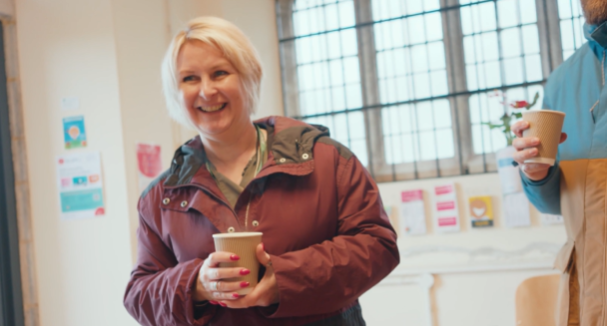
The Cup of Tea project is designed to review our service from the perspective of clients and visitors through Learning Walks. It will also use community engagement, and interviews with our stakeholders such as volunteers, trustees, staff and community representatives. Surveys, operational observation, and wider national research will also help us to discover where improvement or changes can be made.
It can be quite hard to turn the spotlight on ourselves. In the day-to-day delivery of work, often with limited time or capacity, we may reprioritise what we can consider, always dealing with what is directly in front of us.
We all have conscious and/or unconscious bias, but, as a charity, it is important to us that people can see our commitment to our everyone welcome philosophy and see it in action too.
Although not as speedy as the Prime Minister’s pledge to get all rough sleepers off the streets by Christmas, at the end of the two years, we will enact improvements within Newquay Foodbank as needed.
We will also create practical resources that can be shared with other food banks seeking to strengthen equity/equality, diversity and inclusion within their own services.
For more information on the articles reviewed for this blog, check out the references below:
https://youtu.be/DuKvPwnLniU?si=oRIiIOZIGrYIXSke
Intersectionality 101: Definition, Facts and Examples | Human Rights Careers
Rough Sleeping Programme Guidance – GOV.UK
Cornwall gets £3.8m in push to end rough sleeping by Christmas – CornishStuff